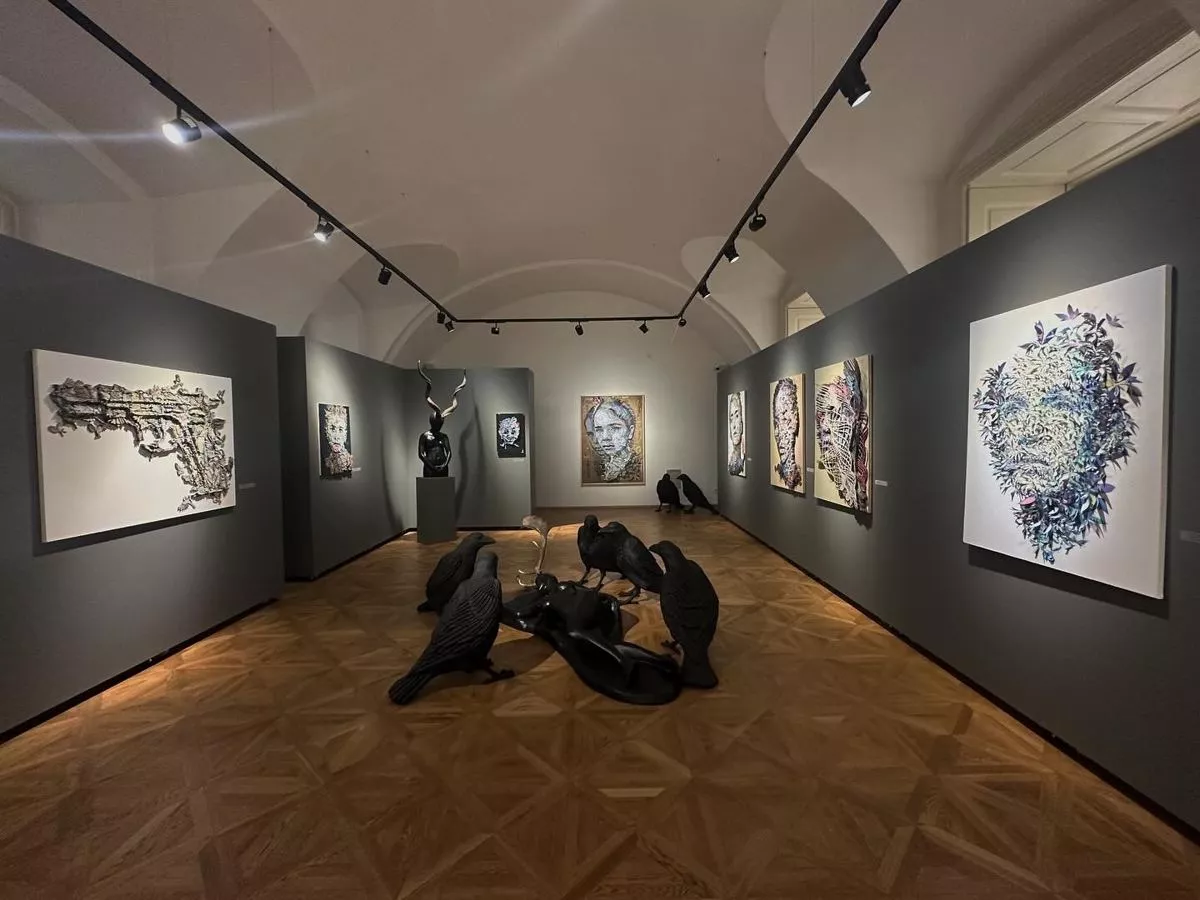
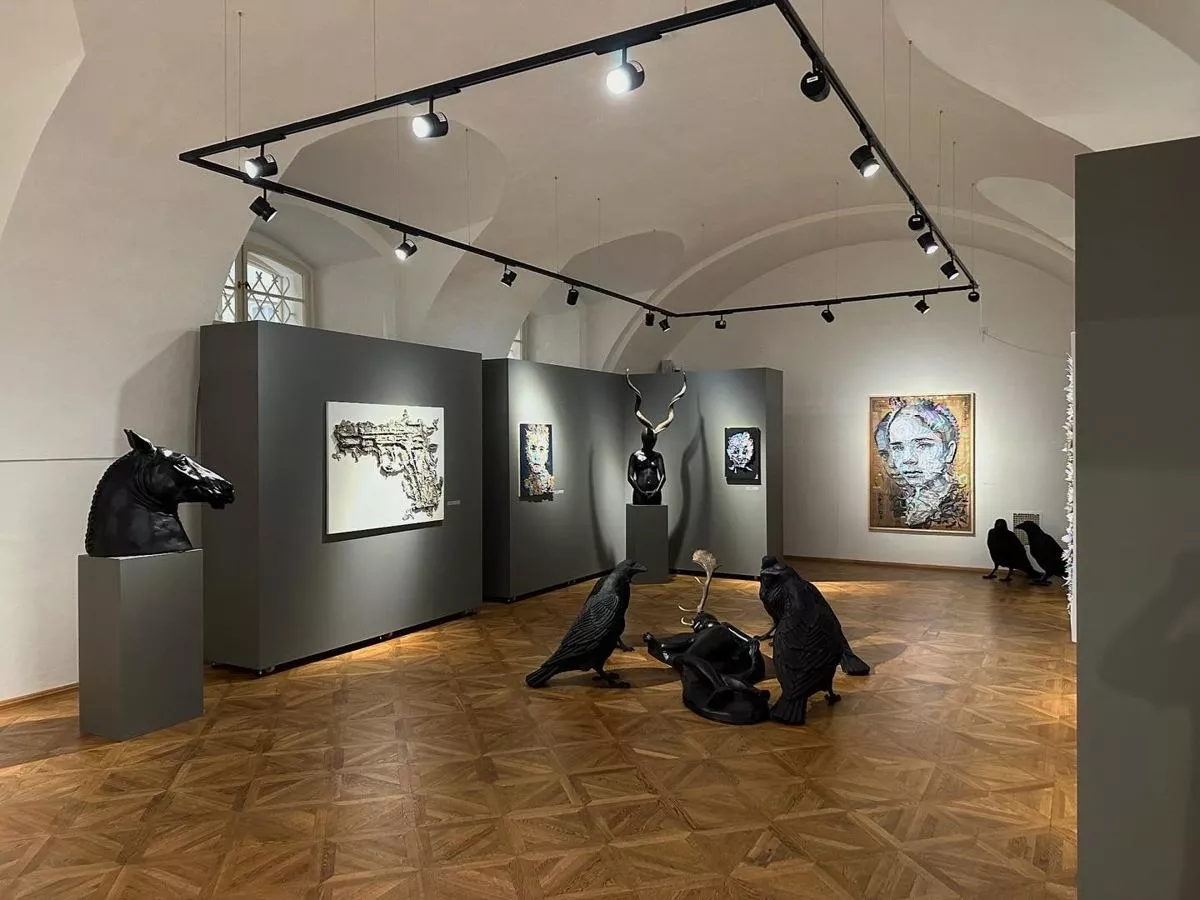
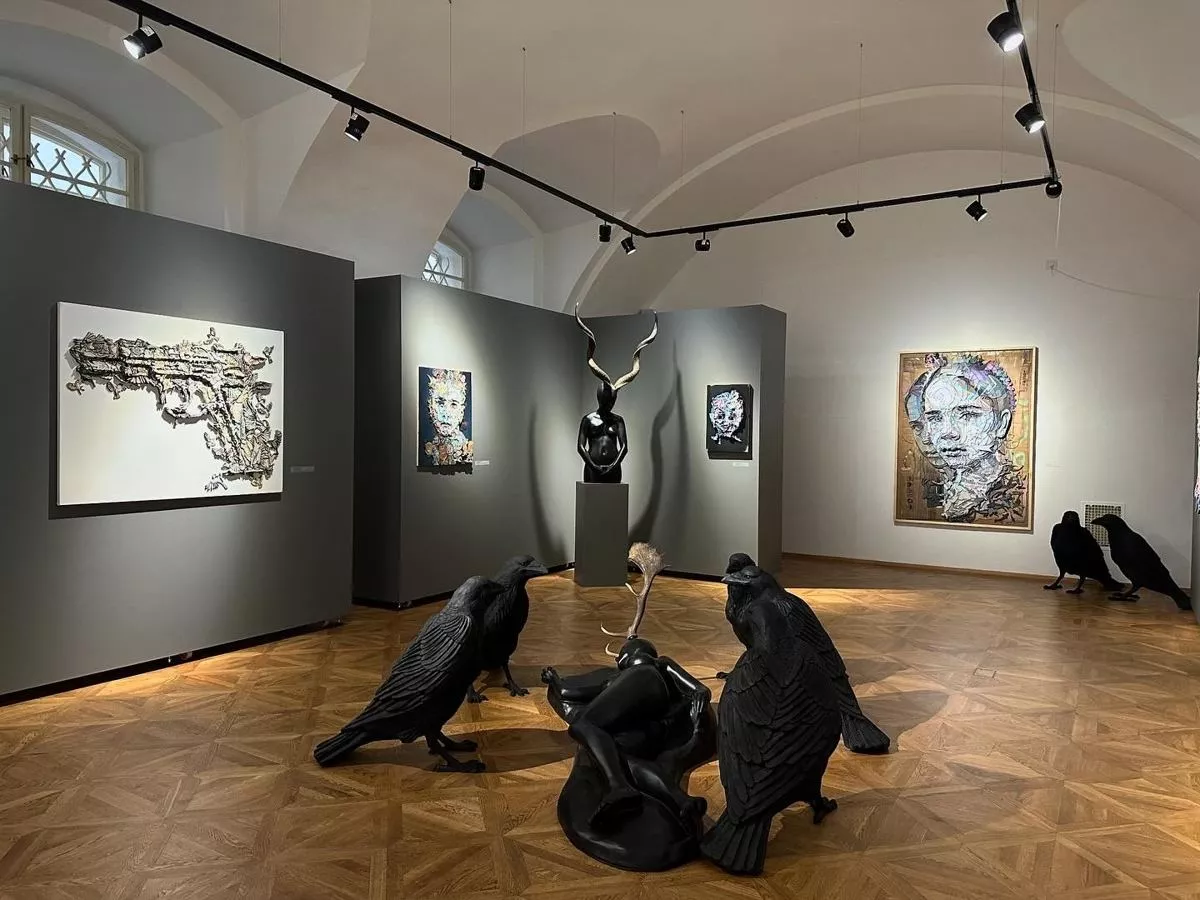
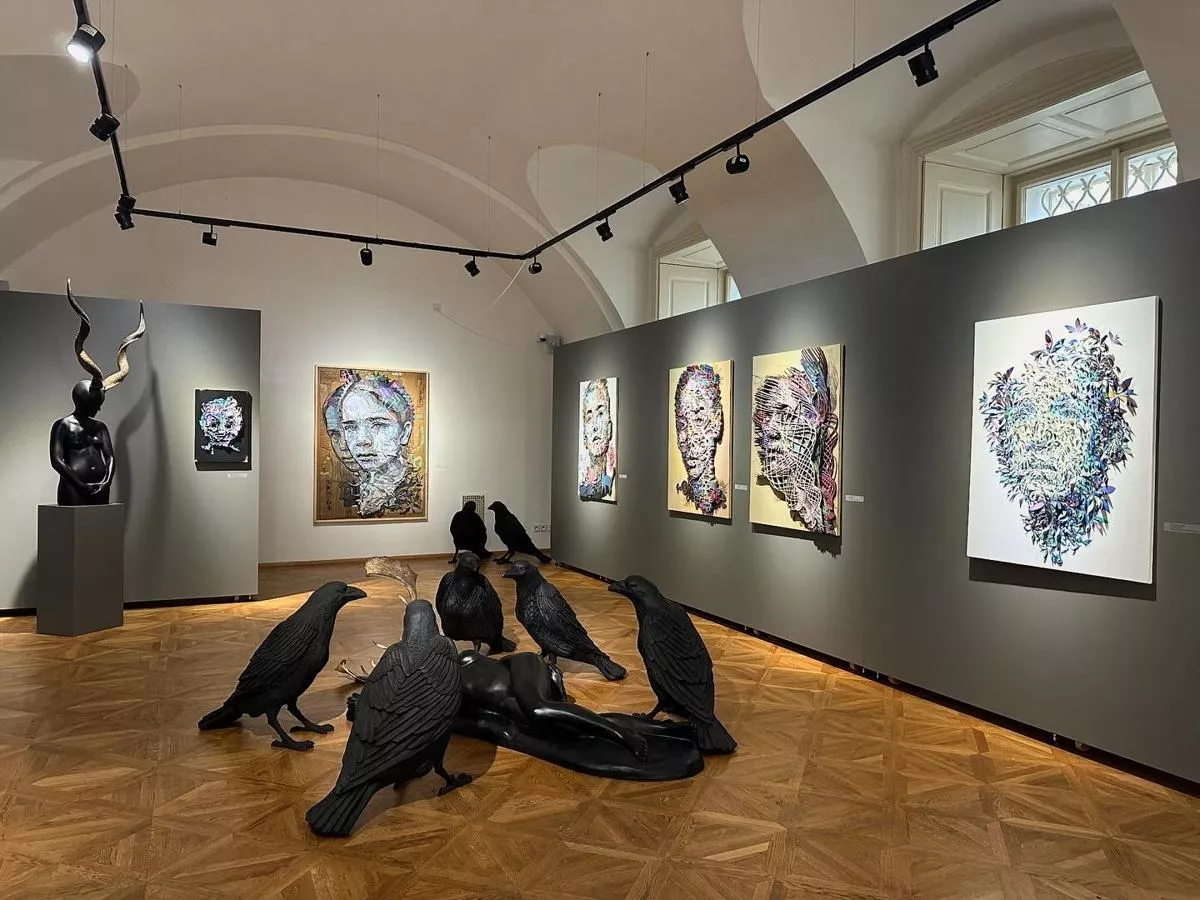
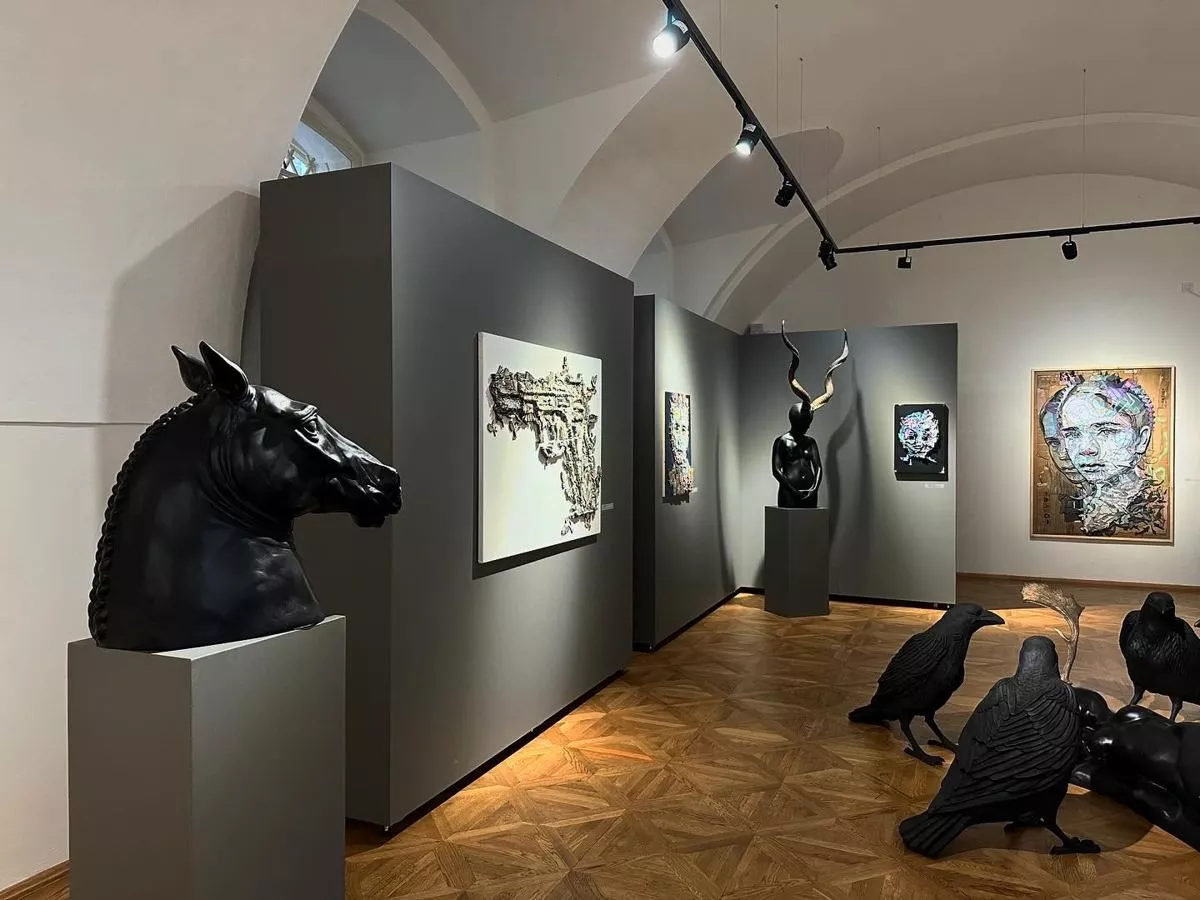
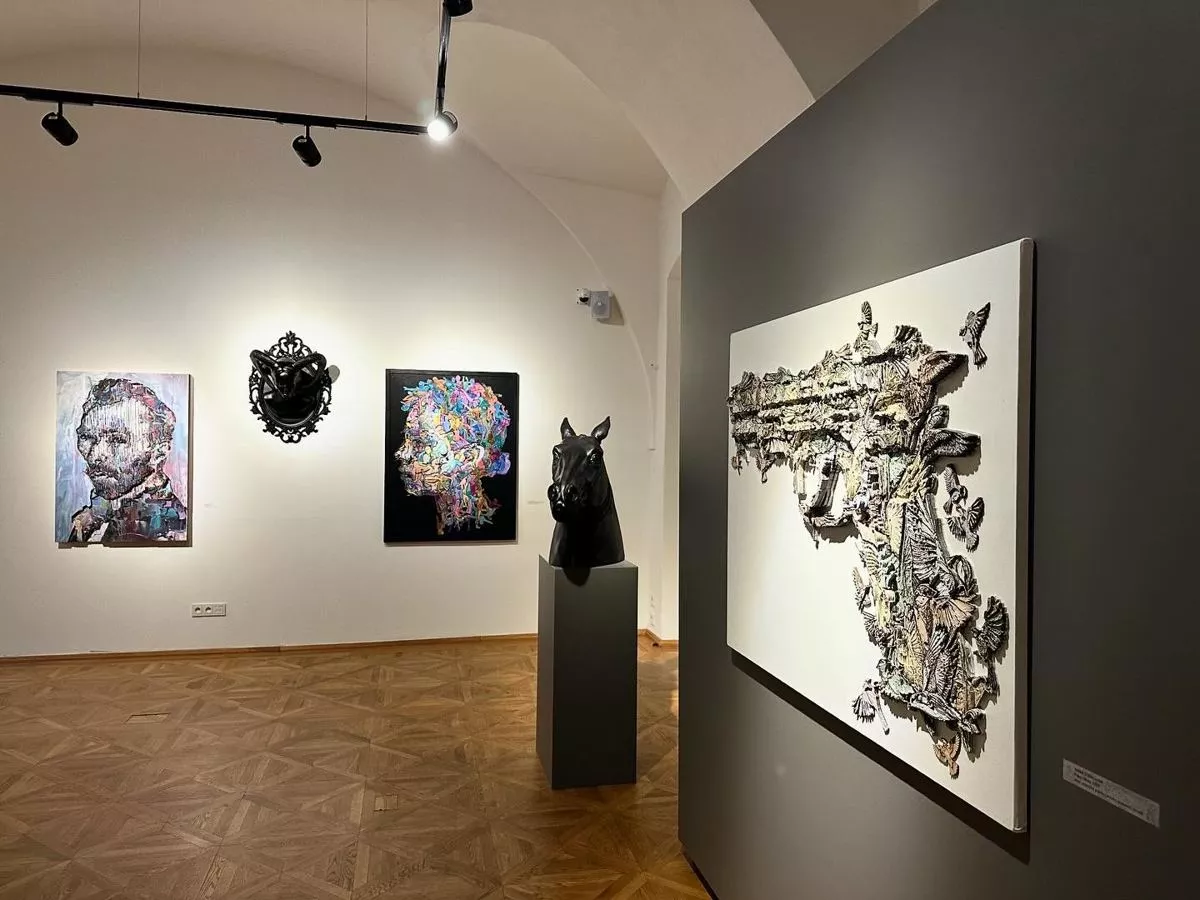
The first joint exhibition of two distinctive women of Czech contemporary art at JSP Art Gallery in the Lesser Town is a provocative union of two seemingly different worlds: the world of mythology, hunting and death, and the world of the faces and lives of particular people.
Paulina Skavova's mythological figures are connected – sensually, sophisticatedly and with gentle irony – with the erotic aspects of hunting, a “bird” wardrobe and female trophies, and draw the viewer into a mysterious world on the border between life and death. Despite their highly detailed technical precision, Skavova idealises her figures, as if trying to break the invisible boundary between the world of people and animals and the world of mythological beings. Myth thus becomes part of everyday reality, enters concrete human and animal stories and, in a feminine way, makes present the eternal questions of the meaning of life and death and of the relationship between man and woman – contradictions blur and disappear behind a veil of the ungraspable.
Compared with Skavova's way of seeing, Ivana Štenclová's approach is more intimate, more “bashful”. She seems to watch her “subjects” from behind a curtain, witnessing their everyday joys and worries and their inner struggles, and – much like Johannes Vermeer of Delft – sealing them in a single moment for eternity. Her figures become immortal together with their small life stories. In an almost mystical way, Štenclová creates a web of relationships with people close to her and far away, who together with her form a strange family “closed in time”. Her work is, in effect, a family album documenting our fleeting presence in time.
What unites the two artists is outstanding craftsmanship, technical and technological refinement and unrepeatable originality within the very broad field of contemporary art. Their work also reflects their personalities – in Skavova's case female self-confidence, courage and strength (despite her slight figure); in Štenclová's, shyness, a magical mysteriousness and at the same time an almost “masculine” rationality.
The exhibition offers a unique opportunity to step out of the rapid flow of everyday events and enter the mythical and mystical stories of people, animals and the quiet witnesses of our present, such as children's toys, colouring books or mysterious ravens watching countless life stories from behind the branches.
— Jarosław S. Pastuszak
The name of the cult rock band with which Paulina Skavova and Ivana Štenclová christened their first joint exhibition carries a touch of eighties nostalgia with a taste of forbidden freedom. It pulses between the opposites of violence and tenderness, pain and pleasure, the urge to kill and the urge to love… Archetypal images are summoned from the collective unconscious, and both artists – each in her own original yet in many ways related manner – give them form as sculptures (Skavova) and relief paintings (Štenclová). They revisit the classical genres of the portrait and the figure (human and animal), freely combine “high” art with elements of pop culture and move confidently in the territory between art and design, whose borders are ever more permeable. They indulge with relish in the sins of decorativeness and exalted beauty, yet never slide into empty pandering or cheap sentimentality. They masterfully take their provocative coquetry to the edge of the abyss where art threatens to tip over into kitsch. At precisely the right moment they stop stroking the viewer's soul and bare their claws (or the thorns of roses?), revealing double-edged subliminal meanings.
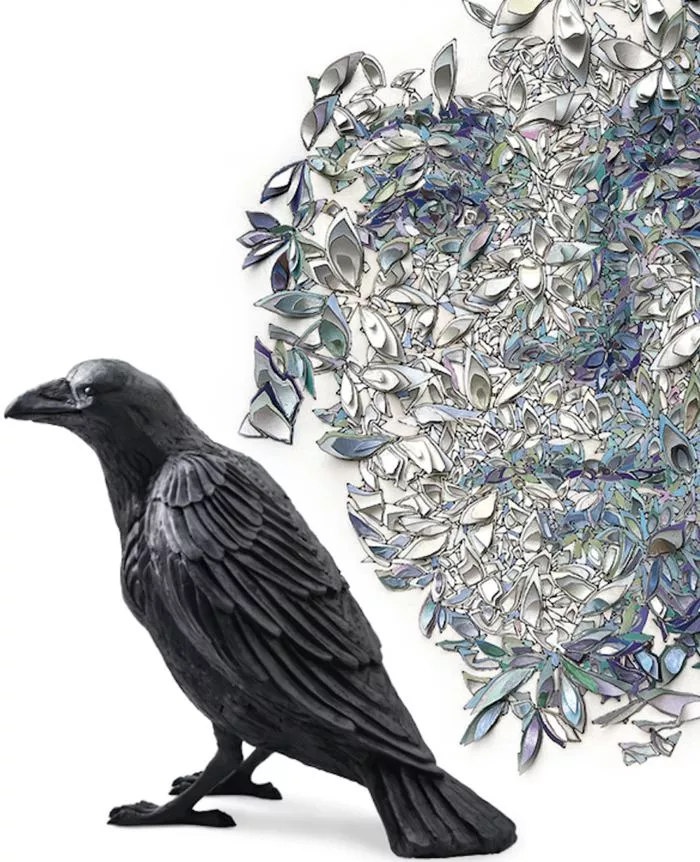
Paulina Skavova (a graduate of Prof. Karel Nepraš's sculpture studio at the Academy of Fine Arts in Prague) uses her figurative groups to retell fairy tales, legends and ancient myths, grafting elements of her personal mythology onto them. This mythology is closely tied to life in the countryside, next to the forest but also to a shooting range where her husband trains top sport shooters. It is natural, then, that hunting has long been a theme of her work. She views it with romantic admiration as a noble activity with its own aesthetics and rituals, but she also sees its darker, degenerate side. She reflects the position of both hunter and hunted, provocatively casting the naked female body as prey. Although she mostly models her sculptures, in several cases she cast them directly from a living model in order to experience “skinning the victim” first-hand. The animal horns that crown the figures degrade them to mere (if highly prized) trophies, yet also elevate the nameless figures to mysterious goddesses of unknown cults. Fluid meanings also run through the Underwear series, which Skavova began at the turn of the millennium. Making delicate corsets, bras and bikinis from the feathers of birds of prey became a meditation for her, while the work gained an unexpectedly conceptual dimension: to use the feathers of dead birds, Skavova had to become the legal owner of their carcasses.
Ivana Štenclová (a graduate of Prof. Jitka Svobodová's drawing studio at the Academy of Fine Arts in Prague) has remained faithful to the portrait since her studies. She has enriched this classical genre with a wide range of inventive techniques that have become her unmistakable signature. Originally she used mainly her own face, which allowed her to express any emotional state or existential situation. Self-portraits and portraits of people close to her were later replaced by portraits of her daughters, who naturally came to fill her life and work. In recent years she has also searched the internet for the faces of anonymous people whose type and expression match her vision. She draws an ornamental structure on the computer, cuts the individual fragments on a laser plotter at home, colours them by hand and builds a relief portrait by layering them. Her iconography ranges from abstract shapes to concrete forms of animals, birds and flowers, and even the silhouettes of comic characters, whose symbolism defines the character or situation of the person portrayed. Experiments with materials and techniques have become an obsession: over her career she has worked with wire embroidery, bobbin lace, decorative paint rollers, plexiglass and enamelled sheet metal. For some time now, however, she has mainly used plywood, which offers almost inexhaustible variety of form and colour. Intoxication with formal finesse could tempt one into repetitive production, but her undeniable technical virtuosity instead inspires ever new ways of depiction that seek new meanings and want to tell the stories written into human faces – the form itself becomes the content of the work.
— Terezie Zemánková